
Operational Intelligence
What is operational intelligence?
A practical way to connect everyday business signals to the decisions that need your attention.


Loading article…
Operational Intelligence
A practical way to connect everyday business signals to the decisions that need your attention.
Loading article…

Reporting helps you understand performance. Operational intelligence brings that context closer to the next decision.

Move beyond a stock count. Look at demand, replenishment, and the exceptions your team can actually act on.
The first useful AI project often starts with shared definitions, fresh records, and a clear way to handle missing data.
Your business probably has more data than anyone can comfortably review. Orders arrive, stock moves, suppliers change delivery dates, and customers ask for updates. The harder question is what deserves attention—and what to do about it.
Operational intelligence connects those signals to the work of running a business. In this guide, we use the term to mean a continuing process of observing operations, interpreting changes in context, and helping a person decide on the next step.
A useful starting point is a recurring question. Which purchase orders need intervention today? Which locations might run out of an important item? Which customer commitments are becoming difficult to meet?
These questions are specific enough to connect data to an owner. They also make it possible to judge whether the system helps. A model score or a chart is an intermediate output; a better-informed decision is the aim.
An operational intelligence workflow can be understood as four connected steps. The precise implementation will depend on the business, its data, and the consequences of a wrong recommendation.
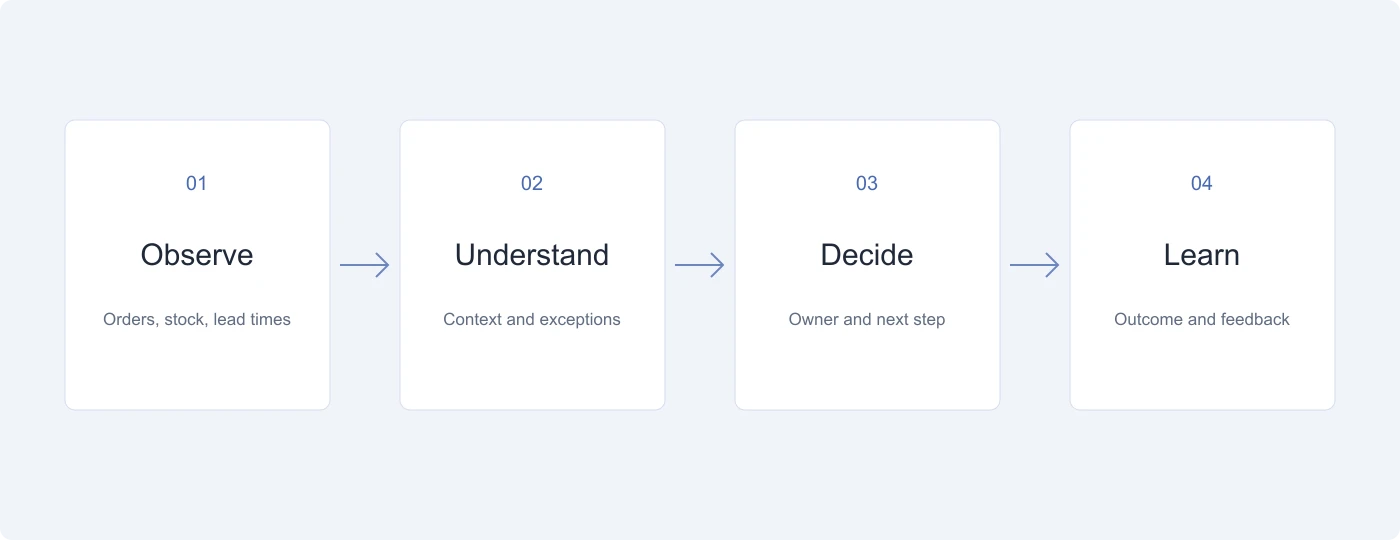
Gather the records relevant to the decision: transactions, available inventory, expected receipts, service requests, or delivery estimates. Decide how fresh each source needs to be. A daily purchase review and an immediate service interruption do not require the same update frequency.
Compare a change with what is expected for that item, location, customer, or process. A drop in sales means something different during a planned closure than during a normal trading day. Calendar events, promotions, and incomplete data can all change the interpretation.
Make the evidence understandable to the person responsible. Explain what changed, why it might matter, and which records support the assessment. Where uncertainty is material, make it visible. The team should be able to challenge the signal.
Record whether the alert was useful, which action was taken, and what happened afterward. An ignored alert may reflect a weak signal, an unclear owner, or an action that was impossible to take. Those are different problems.
Imagine a retailer reviewing stock every morning. One item has enough units for a typical week, but a promotion is increasing demand and the next delivery has slipped.
Each fact may already exist somewhere. The useful insight comes from connecting them: demand is changing, replenishment is delayed, and the current stock position may need attention.
The decision still depends on constraints: transport cost, availability elsewhere, minimum order quantities, and how confidently demand can be estimated. Surfacing these constraints is part of making the recommendation useful.
Start with a small, reviewable workflow:
You do not need every data source connected before learning from one well-defined workflow. You do need enough reliable context to avoid giving an incomplete picture more authority than it deserves.
Reporting remains useful. A monthly review can reveal a pattern that deserves a new operational check. Operational feedback can, in turn, improve the questions a reporting team asks.
For a closer comparison, read operational intelligence versus business intelligence. For an example of choosing actionable signals, see inventory signals worth watching.
The best starting point is a decision you understand well enough to improve—not an ambition to automate the entire business at once.